Tag: digital-marketing

  • From Data to Decisions: Infographics That Guide Solo Female Travelers

    From Data to Decisions: Infographics That Guide Solo Female Travelers

    Data helps us make decisions, especially about traveling solo as a female. However, data is often presented in an indigestible format. Infographics, visual representations of information, make data more readable by helping us see patterns. In this blog post, I will analyze a few infographics on solo female travel, highlighting what they did well and what could be improved.

    Each infographic presents complex information effectively through visual hierarchy, color choices, typography, a balance of text and visuals, and storytelling.
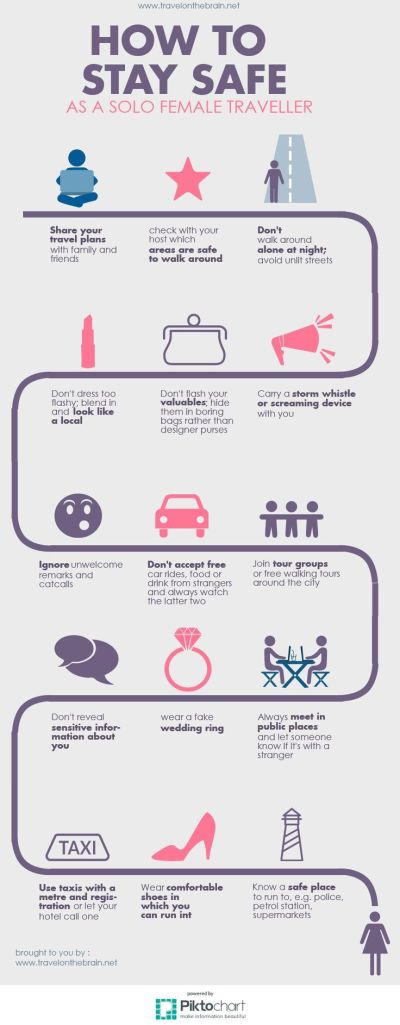
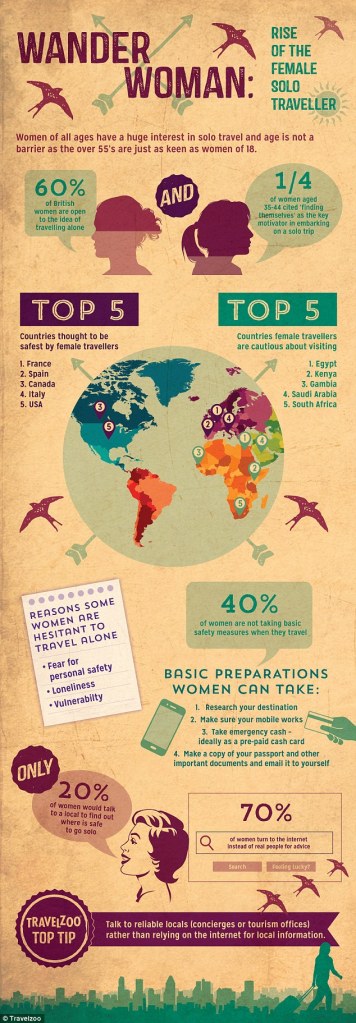
    A key strength of these infographics is their visual hierarchy. The first infographic (safety tips) follows a sequential path, making it easy to follow each tip. Icons and bolded text highlight key points, ensuring clarity. The second infographic (solo traveler motivations) is well-organized, presenting statistics in a digestible format. Using a pie chart for shared room preferences and bar charts for travel styles by age group makes data easy to compare. The third infographic (Wander Woman) uses maps, percentages, and icons to convey safety concerns and travel trends. Structured sections clearly separate key data points. This method makes the infographic visually appealing and easy to navigate. If I were to create an infographic, I would use this approach to enhance visual hierarchy.

    Color significantly impacts readability and engagement. The first infographic uses purples and pinks to create a calm and professional aesthetic, aligning with the theme of safety. The second infographic features bright, inviting colors like yellow and blue, evoking a sense of adventure and optimism. These colors align well with the theme of solo travel benefits. The third infographic uses an earthy, vintage-style palette, reinforcing the theme of travel history and female empowerment. All three contrast well with their backgrounds, making the information readable—something I would apply to my own infographic.

    Typography also plays an important role. These infographics use typography effectively to enhance clarity. The first infographic highlights key safety tips with bolded words, ensuring quick comprehension. The second infographic maintains a simple, consistent font style that enhances readability without unnecessary complexity. The third infographic uses vintage-style fonts that fit the theme while remaining legible. The third infographic’s font is the most visually interesting while still being readable. Typography is crucial in an infographic as it enhances readability, directs attention, and reinforces the overall visual structure. Well-chosen typography ensures key information stands out, making data easier to understand.

    A good infographic balances visuals and text. The first infographic uses icons to illustrate actions, such as a whistle representing a safety device, reducing text dependency. The second infographic blends illustrations and charts, keeping information engaging without overwhelming the reader. The third infographic incorporates maps, graphs, and pictograms to break down data, ensuring visual appeal while maintaining depth. This balance is crucial—too much text can overwhelm, while excessive visuals without explanation can be unclear. In my infographic, I would ensure both elements complement each other effectively.

    Finally, a strong infographic tells a clear story with data. The first infographic presents a step-by-step safety guide for solo travelers. The second infographic explains why people choose solo travel, making it relatable. The third infographic blends statistics, travel trends, and concerns, offering a well-rounded perspective on female solo travel. An infographic should do more than present facts—it should create a narrative that helps the viewer understand the significance of the data.

    These infographics effectively communicate travel-related information through thoughtful design. By incorporating strong visual hierarchy, strategic color use, readable typography, and a balance of visuals and text, they create engaging and informative content. I will apply these principles in my infographic to ensure clarity, engagement, and impact.

  • Beyond the Booking: How Airbnb’s $100M Fund Supports Women’s Safety in Europe

    Beyond the Booking: How Airbnb’s $100M Fund Supports Women’s Safety in Europe

    We hear the term CSR thrown around all the time, but what does it really mean? CSR stands for corporate social responsibility and refers to a company’s commitment to ethical practices, sustainability, and social impact. It’s how they go beyond profit-making to positively affect society.

    Since this blog is about solo female travel, I took a deep dive into one of Airbnb’s CSR initiatives that ties to this theme. In November 2024, Airbnb shared that they will be funding specialist organizations to support women and children at risk of abuse across countries in Europe. The funding will be from the Airbnb Community Fund, which will distribute $100 million USD by the end of 2030. This campaign is particularly relevant to solo female travelers, as it addresses safety and support for women facing gender-based violence, an issue that can impact women traveling alone.

    Airbnb announced an initiative on November 25th, The United Nations International Day for the Elimination of Violence against Women. The initiative comes at a time when there is systemic underfunding of these specialist services, leaving them unable to meet the demands for their support. Airbnb has donated over $1.7 million to organizations across Europe working to end gender-based violence and abuse since 2021. Funding went to organizations in Italy, the UK, Ireland, Spain, and Germany. They carried out a similar initiative in November 2022.

    One communication strategy that Airbnb used to promote this campaign was a blog post which is where I got most of my information about the campaign. On this blog post, there are buttons to post about the initiative on x, Facebook, LinkedIn, Pinterest, or copy the link. This is a smart move because it makes it easy for readers to share Airbnb’s initiative which will drive awareness to the company and the problem they are trying to solve.

    There was not much communication from Airbnb about the initiative, but some people who were involved in the initiative posted on LinkedIn about it. One member of the Host Advisory Board posted about selecting La Grande Casa as one of the beneficiaries. A director of policy strategy at airbnb, as well as a public policy and government relations employee also posted about the initiative. There was a little bit of news coverage from an online British newspaper about Airbnb’s partnership with Womens Aid.

    There was also some influencer marketing involved in the communication of this initiative. An Irish singer-songwriter, Lyra, is a brand ambassador for one of the beneficiaries, Safe Ireland. In an article published in the Irish Times, Lyra was connected with the Safe Ireland and Airbnb “Safe Home, Safe Pathways” campaign. Safe Ireland also had some press releases about their partnership with Airbnb, but these were all in reaction to the first edition of the initiative back in November 2022.

    Lyra pictured on King Street Dublin to Launch Safe Ireland’s Safe Home, Safe Pathways campaign. Photograph: Leon Farrell/Photocall Ireland

    Airbnb also involved its host advisory board in the initiative. The Airbnb host advisory board is a “diverse group of hosts on Airbnb who meet regularly with Airbnb executives to represent the host community’s voice and make sure that hosts’ ideas are heard.” Members of the board were allowed to nominate organizations to receive donations from the community fund, and they identified ending abuse and exploitation as a priority.

    This campaign aligns well with Airbnb’s values of community, connection and, belonging. They want to make sure that their stakeholders feel like they can belong anywhere, which they do by ensuring that accommodations remain a safe space for all travelers, including women and children at risk. What’s more, they are making a real-world impact beyond financial contributions through focusing on providing safe housing for survivors. This initiative is a great way for Airbnb to directly connect its platform to its CSR mission.

    The emphasis on safety and community support throughout the initiative resonates with solo female travelers and reinforces Airbnb’s dedication to providing secure accommodations. However, the communication channels used for this initiative were somewhat limited.

    While Airbnb’s blog post effectively outlined the campaign’s objectives and provided social sharing options, there was not much communication beyond their owned media channels. The initiative received minimal press coverage, and although some Airbnb executives and host advisory board members posted about it on LinkedIn, there was little engagement on mainstream social media platforms like Facebook, X, and Instagram.

    I think the involvement of influencer marketing was a good touch, but it was not strongly leveraged and was only connected with one of the beneficiaries and not so much Airbnb. I think having more of this would have driven engagement and awareness. Perhaps they could have partnered with some female travel influencers or other important public figures in the areas of the beneficiaries.

    Additionally, it would have been nice to see updates on the impact of the donations, such as success stories from beneficiaries. This would further reinforce Airbnb’s long-term commitment to the cause and build trust among its community. Finally, It was a smart move to integrate the host Advisory Board because it not only engaged the host community but also reinforced the idea that Airbnb’s commitment to social impact is driven by those who use the platform.

    By refining its communication strategy and using more diverse channels, Airbnb can maximize the impact of its CSR initiatives and continue to position itself as a leader in driving meaningful social change.